
Few areas of gambling regulation have moved as fast as advertising. In less than a decade, several European markets went from heavily advertised to near-total bans, while others chose targeted restrictions. This briefing compares four of the most cited approaches, notes where courts pushed back, and sets out what the differences mean for operators and their partners.
Four markets at a glance
| Market | Measure | In force | Scope in brief |
|---|---|---|---|
| Italy | "Dignity Decree" (Decreto Dignità) | 14 July 2018 | General ban on gambling advertising and sponsorship, in all media |
| Spain | Royal Decree 958/2020 | 2020–2021 | Strict limits on timing, content and channels; parts later annulled by the Supreme Court |
| Netherlands | Ban on untargeted advertising | 1 July 2023 | No online gambling ads on TV, radio, print or in public spaces |
| Belgium | Royal decree on gambling advertising | 1 July 2023 | Broad ban, with stadium advertising and sponsorship phased out later |
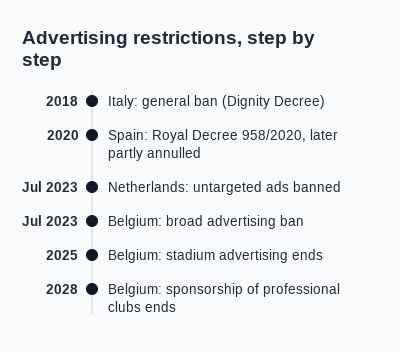
Italy: the general ban
Italy moved first and furthest. The Dignity Decree introduced a general ban on advertising for games and gambling with cash prizes, "however carried out" and in any medium: sport, culture, TV and radio, press, billboards and the internet. Existing sponsorship contracts benefited from a short transitional period, after which sports clubs could no longer be sponsored by gambling operators.
Spain: restrictions, then a court correction
Spain's Royal Decree 958/2020 on commercial communications for gambling activities imposed severe limits, including on advertising through online services. Spain's Supreme Court later found several articles unlawful, among them the provisions that stopped celebrities appearing in gambling ads, restricted welcome promotions for new customers and limited advertising on video-sharing platforms and social networks.
Key point: Spain shows that the legal basis matters as much as the policy. Measures adopted by decree can be challenged in court, and parts of an apparently settled framework can change years later.
Netherlands: targeted, not total
The Netherlands reopened its online market in 2021 and quickly faced criticism over the volume of advertising. From 1 July 2023 a ban on untargeted advertising for online games of chance took effect: no ads via broadcast media, newspapers, magazines or other printed media, or in public spaces. Targeted online advertising remained possible under strict conditions, and the rules aim to keep ads away from minors, young adults and other vulnerable groups.
Belgium: a phased ban
Belgium's royal decree, published in March 2023, banned gambling advertising from 1 July 2023 on television, radio, in cinemas, newspapers and magazines, in public spaces and online on websites and social media. Further steps were scheduled: a ban on stadium advertising from 1 January 2025 and an end to sponsorship of professional sports clubs from 1 January 2028.
What this means for operators
- Acquisition costs rise. With mass media closed, operators rely more on owned channels, CRM and search, where competition is intense.
- Sponsorship portfolios shrink. Clubs in affected markets have had to replace gambling sponsors, and international deals need territorial care.
- Affiliates face scrutiny. In many markets the operator remains responsible for third-party marketing. We explain how that works in How the Affiliate Model Works in iGaming.
- Compliance becomes cross-border. A campaign legal in one market can breach rules in a neighbouring one when it is broadcast or posted online.
Watch out: This overview summarises published measures and their reported scope. Rules change and details matter: secondary regulation, guidance and court rulings can alter how a measure applies. Operators should rely on local legal advice, not summaries.
The spectrum
The four markets illustrate a spectrum rather than a single European model: a general ban (Italy), a phased broad ban (Belgium), a targeted ban (Netherlands) and detailed restrictions partly reshaped by courts (Spain). Other markets, including Great Britain, rely mainly on advertising codes and industry measures rather than outright bans.
For the tax side of market economics, try the GGR and gaming tax calculator.
- Italy banned gambling advertising generally from 2018; Belgium and the Netherlands restricted it from 1 July 2023.
- Spain's 2020 decree was partly annulled by the Supreme Court.
- Restrictions push operators towards owned channels and make cross-border compliance harder.
Use the overview as a research map
Identify the country, advertising channel and date before applying any example. A restriction discussed in litigation is not interchangeable with a rule currently in force. Follow the linked official materials and obtain qualified local advice for a real campaign; this comparison is not a compliance clearance.
18+ only. Gambling involves risk. See our Responsible Gambling page.