
Responsible gambling used to be presented as a voluntary commitment. In most regulated markets it is now a set of enforceable requirements, and the list keeps growing. This briefing groups the most common measures into four layers and uses Great Britain, where the rules are well documented, to show what they look like in practice.
Layer 1: tools customers can use
These are the controls a player sets for themselves:
| Tool | What it does |
|---|---|
| Deposit and loss limits | Cap the money a customer can put in or lose over a period |
| Reality checks | Remind the customer how long they have been playing |
| Time-outs | Suspend the account for a short period |
| Single-operator self-exclusion | Block the customer from one operator; in Great Britain the minimum period is six months |
The Gambling Commission lists limit-setting, reality checks, time-outs and self-exclusion among the tools available, alongside gambling-blocking software and card blocks offered by banks.
Layer 2: market-wide schemes
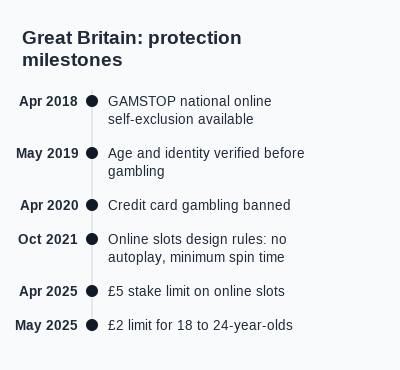
Single-operator tools are easy to get round by opening another account. Multi-operator schemes close that gap. In Great Britain, GAMSTOP, available since April 2018, lets people exclude themselves from the websites and apps of all licensed online gambling businesses for a period they choose, and licensed online operators must take part.
Layer 3: product rules
Some protections are built into the products themselves. In Great Britain:
- Credit cards cannot be used to gamble, online or offline, since 14 April 2020, with an exception for non-remote lotteries.
- Online slots stake limits: £5 per spin for adults aged 25 and over since 9 April 2025, and £2 for those aged 18 to 24 since 21 May 2025. The limits apply to online slots, not to other casino games such as roulette or blackjack.
Key point: Product rules protect everyone by default, without relying on the customer to set a limit. That is why regulators have moved from optional tools towards built-in caps.
Layer 4: operator duties
The final layer puts the responsibility on the operator: identifying customers who may be experiencing harm and acting on it. This includes monitoring indicators such as time and money spent, changes in behaviour and patterns like repeated failed deposits, and interacting with customers when risk is detected. Verification rules also play a part: since 2019, online operators in Great Britain must verify age and identity before a customer gambles, as explained in KYC and AML: What Operators Must Do.
How other markets compare
The four layers appear in many regulated markets, with different settings:
- Self-exclusion registers run by regulators or lotteries, often covering both land-based and online gambling.
- Mandatory limits that customers must set at registration in some jurisdictions, rather than optional ones.
- Advertising restrictions, which act as a fifth layer by reducing exposure: see Advertising Rules for Gambling.
Watch out: Tools only protect customers within the regulated market. Unlicensed sites have no obligation to honour limits or self-exclusion, which is one reason regulators treat the black market as a consumer-protection issue, not just a tax issue.
What it means for operators
- Product design must include limits and exclusion from day one.
- Data and monitoring systems must be able to detect harm indicators.
- Compliance costs rise, but enforcement for failures is more expensive still.
- Regulatory protection works in layers: customer tools, market-wide schemes, product rules and operator duties.
- Great Britain banned credit card gambling in 2020 and capped online slots stakes at £5 (and £2 for 18 to 24s) in 2025.
- Protections apply only in the licensed market, which is why black-market play matters.
Distinguish availability from effectiveness
A control being listed in a policy does not establish how easily a person can activate or retain it. Check implementation, reversal conditions and access to support in the applicable jurisdiction. The regulatory examples are a starting point for current official verification, not a substitute for it.
18+ only. Gambling involves risk. See our Responsible Gambling page.